Chasing Light and Legacy in Nizwa: Where Art Meets the Soul of Oman
You know that feeling when a place just gets you? Nizwa did that to me. Beyond the fortress walls and desert winds, it’s the art—the colors, textures, whispers of heritage in every carving—that stole my heart. This isn’t just a travel post; it’s a love letter to a city where culture lives in the details. If you’ve ever wanted to photograph a story, not just a scene, Nizwa will rewrite your lens. Here, every shadow has a memory, every doorway frames a life shaped by centuries of tradition, and every artisan’s hand carries forward a legacy. For women who travel not just to see but to feel, to understand and connect, Nizwa offers something rare: authenticity that doesn’t perform, but simply is.
The First Glimpse: Arriving in Nizwa with a Photographer’s Eye
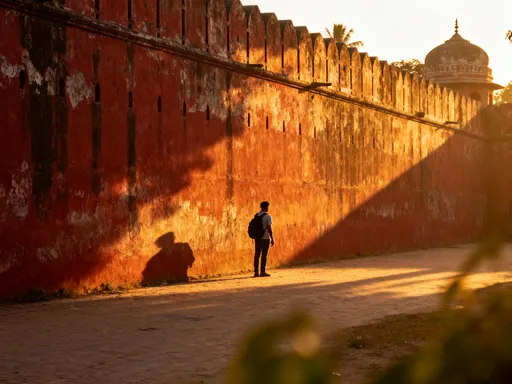
As the sun rises over the Hajar Mountains, a soft golden light spills across the dusty plains leading into Nizwa, casting long, delicate shadows on the ancient stone of the city’s outer walls. The air is cool, still carrying the quiet hush of dawn, broken only by the distant call to prayer echoing from a minaret. This is the perfect moment to arrive—not in the heat of midday, when the sun beats down relentlessly, but in those early hours when light is gentle and the city stirs slowly to life. For photographers, especially, this first glimpse is more than a scenic welcome; it’s an invitation to witness time unfolding in layers.
Nizwa, once the capital of Oman and a center of Islamic scholarship, stands as a testament to the country’s deep-rooted history. Unlike more modernized cities along the coast, Nizwa has preserved its soul through centuries of change. It is not frozen in time, but rather, it lives in rhythm with its past. The blend of scholarly tradition, agricultural innovation, and artisan craftsmanship creates a cultural richness that feels both grounded and luminous. As you enter through the city’s main approach, the towering presence of Nizwa Fort rises ahead, its circular bulk commanding the skyline like a sentinel.
What sets Nizwa apart in Oman’s cultural landscape is its role as a historical crossroads. Positioned between the mountains and the desert, it was once a vital hub for trade, connecting inland oases with coastal ports. Merchants brought spices, textiles, and knowledge, while scholars gathered in its mosques and schools. This confluence of commerce and culture nurtured a unique artistic identity—one that values both function and beauty. Today, visitors can still sense that legacy in the precision of a silver engraving, the symmetry of a carved wooden door, or the careful stacking of stones in a centuries-old irrigation system.
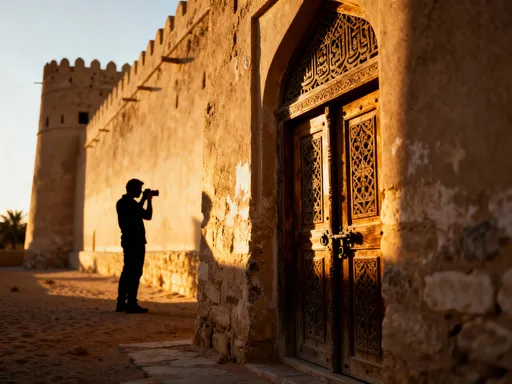
For those arriving with a camera in hand, timing is everything. To capture Nizwa at its most photogenic, aim to reach the city between 5:30 and 7:00 a.m., especially during the cooler months from October to April. Parking near the eastern entrance of the fort offers an unobstructed view for approach shots, where the rising sun highlights the texture of the limestone walls. A wide-angle lens works well here, allowing you to frame the fort against the vast Omani sky. Even without professional gear, a smartphone with a good camera can produce stunning results if used in natural light. The key is patience—waiting for that perfect slant of light, for the moment when the city seems to breathe in unison with the landscape.
Nizwa Fort: A Masterpiece of Form and Function
Rising from the earth like a natural extension of the mountain, Nizwa Fort is more than a defensive structure—it is a narrative in stone. Built in the 17th century under the rule of Imam Sultan bin Saif, the fort exemplifies Omani architectural ingenuity, blending military strategy with aesthetic harmony. Its massive cylindrical tower, 40 meters high and 37 meters in diameter, was designed not only to withstand attacks but also to regulate temperature and airflow, ensuring comfort even in the fiercest summer heat. Every element, from the thick walls to the narrow slits for archers, speaks of a civilization that valued both survival and dignity.
For photographers, the fort offers endless opportunities to explore symmetry, texture, and the interplay of light and shadow. Inside the spiral ramp that winds up the tower, sunlight filters through small openings, creating patterns that shift with the hour. These beams highlight the rough-hewn stone and the precise craftsmanship of the vaulted ceilings. A wide-angle lens captures the grandeur of the ascent, while a macro setting reveals the tiny cracks, mineral deposits, and hand-carved details that tell of centuries of wear and care. The contrast between light and dark in these corridors is not just visually striking—it evokes a sense of mystery, as if the walls themselves are whispering secrets of the past.
One of the most powerful visual elements within the fort is the network of hidden chambers and escape routes. These were not mere hiding places but sophisticated components of a larger defensive system. Today, they serve as metaphors for resilience and foresight—qualities deeply embedded in Omani culture. Photographing these spaces requires sensitivity; rather than staging dramatic shots, it’s more powerful to let the architecture speak for itself. A single shaft of light illuminating a stone bench, or a close-up of a rusted iron latch, can convey more emotion than any posed scene.
To avoid crowds, which can be heavy during midday, especially on weekends, plan your visit for early morning or late afternoon. The golden hour, just before sunset, bathes the exterior in warm tones, enhancing the fort’s monumental presence. A telephoto lens can isolate details like the intricate woodwork of the main gate or the geometric patterns in the stonework. For those interested in drone photography, note that flying is restricted near historical sites without prior permission. Instead, focus on ground-level compositions that honor the fort’s scale and serenity. Remember, the goal is not just to take pictures, but to understand the story behind every stone.
The Souq: Where Culture Comes Alive in Color and Craft
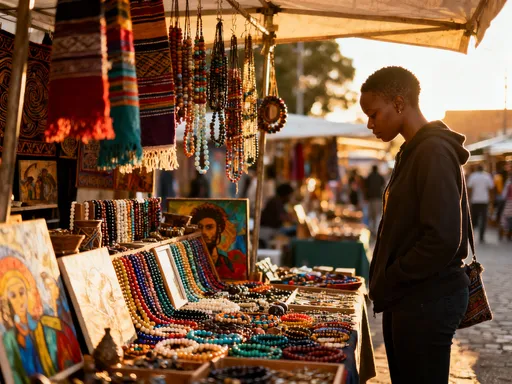
Just steps from the fort lies the Nizwa Souq, a vibrant tapestry of sound, scent, and color. Here, the air is rich with the earthy aroma of frankincense, the sharp tang of cumin and turmeric, and the sweet fragrance of dried dates. Rows of stalls overflow with handcrafted goods—silver jewelry, woven baskets, leather goods, and the iconic Omani *khanjar*, or curved dagger. This is not a tourist market staged for visitors; it is a living marketplace where locals come to buy, sell, and socialize. For the observant traveler, the souq is a window into the heart of Omani daily life.
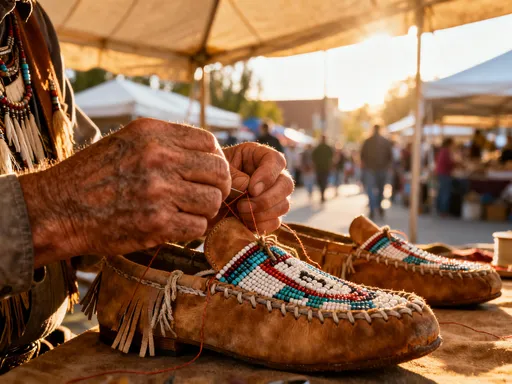
Photographing the souq requires both technical skill and ethical awareness. The temptation to snap candid shots of artisans at work is strong, but respect must come first. A simple smile and a gesture of asking permission—often met with a nod or a warm “Yes, please”—can transform a moment of intrusion into one of connection. Many silversmiths, for instance, take pride in their craft and are happy to be photographed if approached politely. Their hands, marked by years of hammering and polishing, tell a story of dedication that no caption could fully capture.
The *khanjar* is more than a weapon; it is a symbol of Omani identity, often worn during formal occasions and passed down through generations. Its hilt, typically made of horn or wood, is inlaid with silver in intricate patterns, while the sheath is decorated with embossed metalwork. Close-up photography reveals the precision of these engravings—each line a testament to patience and tradition. When photographing a *khanjar*, focus on the details: the curve of the blade, the texture of the leather strap, the reflection of light on polished silver. These images, when shared with context, become more than souvenirs—they become acts of cultural preservation.
Lighting in the souq can be challenging, with deep shadows under cloth awnings and harsh overhead sun. To manage this, use natural light to your advantage. Position yourself near the edges of the market, where diffused sunlight filters through fabric, creating soft illumination. Avoid using flash, which can startle people and flatten textures. Instead, increase your ISO slightly or use a lens with a wide aperture to maintain clarity. When photographing textiles, such as handwoven *kumma* caps or embroidered *dishdashas*, shoot from a slight angle to show both pattern and texture. The goal is to capture authenticity—not perfection, but realness: a vendor adjusting his wares, a child reaching for a date, a craftsman pausing to wipe his brow.
Beyond the Fortress: Hidden Courtyards and Living Heritage
Away from the main thoroughfares, Nizwa reveals another layer of beauty—its residential alleys, where traditional Omani houses stand like quiet poems in stone and wood. These homes, often centuries old, feature intricately carved wooden doors, latticed windows known as *mashrabiya*, and small courtyards shaded by date palms. Unlike museum-like reconstructions, these are lived-in spaces, where families grow herbs, hang laundry, and gather in the cool of the evening. To walk these streets is to witness heritage not as a relic, but as a living practice.
Photographing these neighborhoods requires discretion and respect. Many homes are private, and while their exteriors are visually striking, entering without invitation is inappropriate. Instead, focus on architectural details—peeling paint on a doorframe, the geometric patterns of a window screen, the way sunlight filters through a palm frond onto a mud-brick wall. These elements, when composed thoughtfully, convey a sense of place without crossing boundaries. A prime lens with a moderate focal length, such as 50mm, works well for capturing both intimacy and context.
Some families open their homes as informal craft workshops, where visitors can watch potters shape clay on foot-powered wheels or weavers dye wool with natural pigments. These moments are precious, and photographing them should be done with permission and gratitude. Rather than rushing through with a camera, take time to engage—ask about the process, learn a few words in Arabic, and perhaps purchase a small item to support the artisan. When you do take photos, wait for natural moments: a potter’s hands smoothing the rim of a vase, a weaver threading a loom, a grandmother teaching a child to roll dough in a courtyard kitchen.
The connection between daily life and artistic expression in Nizwa is profound. Date farming, for example, is not just an agricultural activity but a cultural cornerstone. The *aflaj* irrigation system, a UNESCO-recognized marvel of engineering, channels mountain water to groves of date palms, sustaining both economy and tradition. Photographing a farmer harvesting dates at dawn, his face shaded by a woven hat, or a family packing fruit for market, offers a glimpse into a rhythm of life that has changed little over generations. These images, when shared with care, honor the dignity of labor and the beauty of continuity.
The Green Mountains: Nature as Cultural Canvas
A short drive from Nizwa leads to the breathtaking highlands of Jebel Akhdar, or the “Green Mountain,” part of the larger Hajar range. Here, terraced farms climb steep slopes, their stone walls built by hand over centuries to retain soil and water. Villages like Misfat al Abriyeen cling to cliffsides, their traditional houses blending seamlessly into the landscape. This is not untouched wilderness, but a cultivated harmony between people and nature—a living canvas where agriculture and artistry converge.
The contrast between the arid plains below and the lush terraces above is striking. In spring, the orchards burst with apricot and pomegranate blossoms; in summer, figs and grapes ripen under the sun. The *aflaj* system continues to feed these farms, its channels carved into rock, guiding water with quiet precision. Photographing this landscape requires a shift in perspective—from the monumental to the intricate. A wide-angle lens captures the vastness of the terraces, while a macro setting reveals droplets on a leaf or the texture of a stone wall covered in lichen.
Morning mist often drapes the valleys, softening edges and adding a dreamlike quality to the scene. This is the ideal time to shoot, when light is diffused and colors are rich. Look for vantage points along the hiking trails that offer layered compositions—foreground trees, mid-level homes, and distant peaks. A polarizing filter can enhance the contrast between sky and land, but avoid overprocessing in editing; the beauty here is in its subtlety. For those interested in cultural storytelling, include human elements: a farmer guiding a donkey laden with firewood, children walking to school on a narrow path, women gathering herbs in a shaded grove.
While the scenery is undeniably photogenic, it’s important to remember that these are not abandoned ruins, but thriving communities. Always ask before photographing people, and respect signs indicating private property. Some families offer homestays or guided walks, providing an opportunity to learn directly from residents. These experiences, more than any photograph, deepen understanding. When you return with images of a terraced farm at sunrise or a village courtyard at dusk, they carry not just visual beauty, but the weight of human care and resilience.
Light, Shadow, and the Rhythm of Daily Life
In Nizwa, light is not just a condition for photography—it is a character in the story. The way it slants across a courtyard at 4:00 p.m., casting long shadows through a carved window, or how it glows on a silversmith’s hands as he works by a doorway, transforms ordinary moments into something sacred. For the traveler with a camera, learning to “chase the light” is not about chasing perfection, but about aligning with the city’s natural rhythm. This means rising early, resting during the midday heat, and returning to the streets as the sun begins to soften.
The daily rhythm of Nizwa is shaped by prayer, market cycles, and agricultural work. The call to prayer, repeated five times a day, marks the passage of time with a haunting melody that echoes through stone alleys. Photographing these moments requires stillness—waiting, listening, letting the scene unfold. A silhouette of a man walking toward the mosque at dusk, or a shopkeeper closing his stall as the sky turns amber, speaks of routine and devotion without needing explanation. These are not staged moments, but glimpses into a life lived with intention.
Shadows, too, are powerful tools in visual storytelling. They can suggest mystery, depth, and continuity. A photograph of a child’s shadow stretching across a sunlit wall, or the dark interior of a souq stall with a single beam illuminating a silver dagger, invites the viewer to imagine what lies beyond the frame. Avoid exoticizing these images; the goal is not to portray Nizwa as “mysterious” or “other,” but as deeply human. Use composition to emphasize dignity, balance, and connection—between people, places, and traditions.
Staying present while shooting is one of the greatest challenges—and rewards—of travel photography. It’s easy to get caught in the mechanics of focus, exposure, and framing, but the most meaningful images come from moments of genuine engagement. Put the camera down. Smile. Say “Shukran” when someone offers you tea. Let the act of seeing be reciprocal. When you do raise your lens, do so with purpose, not just to collect images, but to honor what you’ve been allowed to witness.
Why Nizwa Changes the Way You See Culture Through a Lens
Photographing Nizwa does more than fill a memory card—it changes the way you see. It teaches you to look beyond the surface, to notice the curve of a hand on a chisel, the pattern of water in a centuries-old channel, the quiet pride in a craftsman’s eyes. This city doesn’t offer spectacle; it offers substance. And in a world where travel is often reduced to checklists and hashtags, Nizwa reminds us that the deepest connections come from slowing down, listening, and seeing with care.
The responsibility of the traveler-photographer is significant. Every image shared becomes part of a larger narrative about Oman and its people. Represent Nizwa with truth—show its beauty, but also its normalcy, its strength, its everyday grace. Avoid clichés, avoid poverty tourism, avoid reducing culture to a backdrop. Instead, focus on collaboration: ask, listen, credit, and whenever possible, support local artists by purchasing their work.
Practically, a lightweight setup works best—mirrorless camera, 24-70mm lens for versatility, a tripod for low-light interiors, and extra batteries. Edit with restraint, preserving natural tones and contrasts. When sharing online, write captions that educate—mention the name of an artisan if permitted, explain the significance of a tradition, or simply express gratitude. These small acts turn photographs into bridges, not trophies.
In the end, Nizwa is not just a destination, but a teacher. It shows us that art is not separate from life, but woven into it—through a carved door, a silver pattern, a terraced field. When you return home, your photos will do more than decorate walls. They will remind you of a place where culture is lived, not performed, and where every image carries the quiet weight of legacy. And perhaps, they will inspire others to travel not just to see, but to understand.